logo
Good price  online

products details

Created with Pixso. Home Created with Pixso. Products Created with Pixso.
Toast Making Machine
Created with Pixso. Laminated Toast Loaf Production Line High Capacity Danish Bread Processing Plant

Laminated Toast Loaf Production Line High Capacity Danish Bread Processing Plant

Brand Name: Zline (Industrial Dough Solution)
Model Number: Customized (Based on Capacity)
MOQ: 1 Set (Support Production Test)
Price: Negotiable
Delivery Time: Scheduled by Project Scale (30-45 Days)
Payment Terms: L/C,T/T
Detail Information
Place of Origin:
China
Certification:
CE
Product Name:
Industrial Laminated Toast Loaf Bread Production Line
Application:
Laminated Toast, Danish Loaf, Sandwich Tin Bread, Pastry
Processing Method:
Stress-free Sheeting, Fat Enclosing & Laminating
Table Width:
800mm (Standardized & Customized Available)
Production Capacity:
2,000 - 25,000 Pcs / Hr (Depending On Product Sizes)
Product Weight Range:
25 G - 1,000 G
Main Material:
Food Grade 304 Stainless Steel
Engineering Standard:
High Automation, Modular European Standard Assembling
Packaging Details:
Reinforced Wooden Crate for Heavy Industrial Equipment
Supply Ability:
Customized Project Supply Capacity
Product Description
Industrial Bakery Processing Equipment

Industrial Laminated Toast Bread Production Line, 800 mm Width, 2,000–25,000 Pieces per Hour

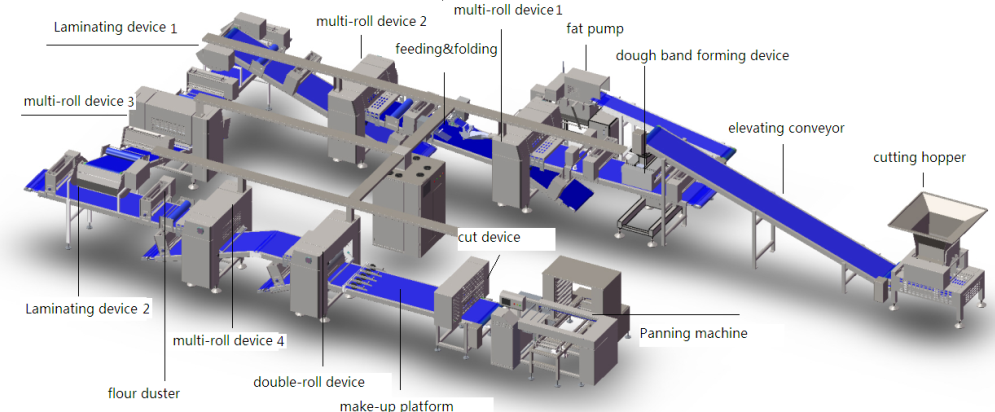
We configure this modular production line for laminated toast loaves, Danish loaves and sandwich tin bread. The process platform combines dough feeding, continuous sheeting, fat enclosing, lamination, make-up, servo cutting and automatic panning. Equipment scope and line speed are matched to the product specification and factory layout.

800 mmStandard table width
2,000–25,000Pieces per hour, configuration-dependent
25–1,000 gListed dough piece weight range
1 SetListed minimum order quantity

The stated output is a project range, not a guaranteed rate for every recipe. Actual throughput depends on piece weight, product geometry, lane count, selected modules and downstream capacity. Confirm the target rate using representative production trials and written acceptance criteria.

Engineering Reference

Technical Specifications

Parameter Specification
Product / line Industrial laminated toast loaf and tin bread production line; ZMB900 line description
Model configuration Customized project configuration; listed model options include 2-head rotary (30–50 bpm), 4-head high-speed (60–80 bpm) and 8-head production line (100–120 bpm)
Production capacity 2,000–25,000 pieces/hour, depending on product size and configuration
Product weight range 25–1,000 g
Standard table width 800 mm; customized width subject to project confirmation
Processing method Stress-free sheeting, fat enclosing, laminating and progressive dough reduction
Roller modules 3–6 multiroller sets described as configurable; confirm quantity and adjustment range in the final bill of materials
Make-up and transfer Product-specific forming accessories, servo cutting and automatic panning can be selected for the agreed product and tray format
Main material Food-grade 304 stainless steel, as stated in the product specifications
Product applications Laminated toast, Danish loaf, sandwich tin bread and related pastry products
Certification status CE is listed in the product specifications; request the applicable declaration and verify its model/configuration scope before procurement
Minimum order quantity 1 set; production testing can be arranged
Indicative delivery schedule 30–45 days, scheduled according to project scale and confirmed configuration
Packaging Reinforced wooden crate for heavy industrial equipment
Payment terms L/C or T/T, subject to the sales contract
Place of origin China

Electrical supply, total line footprint, installed power, air requirements, conveyor elevations, guarding, control architecture and utility connection points are configuration-specific. They should be recorded in the approved technical annex before manufacture.

Line Configuration

Modular Dough Processing Platform

Continuous Dough Feeding

Dough batches are transferred to the forming section, where the feed arrangement establishes a continuous dough band for subsequent rolling and calibration.

Progressive Sheeting

Multiroller and gauging stages progressively reduce dough thickness. The number of roller sets and the target sheet profile are selected for the product recipe.

Fat Enclosing and Lamination

Feeding and folding mechanisms support the enclosing and layering process required for laminated dough products. Final layer structure must be validated with the intended dough and fat formulation.

Make-up and Automatic Panning

Forming accessories, lane guides, servo cutting and panning can be configured to match loaf geometry, piece weight, baking tins and tray dimensions.

Process Sequence

Coordinated Production Workflow

Bulk FeedingDough batches are loaded into the feed or cutting hopper for controlled transfer.
Dough Band FormingAn elevating conveyor transfers portions to the band-forming section to establish a continuous sheet.
Thickness CalibrationMultiroller and double-roll devices progressively reduce the sheet toward the target profile.
Dividing and SlittingThe dough band is divided longitudinally according to the selected product and lane arrangement.
Make-up and ShapingProduct-specific accessories roll, shape or layer the dough into the required loaf format.
Servo Cutting and PanningFormed pieces are cut and deposited into baking tins or trays for downstream proofing and baking.
Manufacturing and Acceptance

Quality Control and Project Verification

Food-Contact Construction

Confirm the specified 304 stainless steel grade for each food-contact component, together with surface finish, weld treatment and material documentation required by the buyer.

Process Trial

Run the buyer’s representative dough formulation and target product sizes. Record sheet thickness, piece weight, lane stability, reject rate and sustained output during the agreed test.

Mechanical and Electrical Inspection

Review conveyor tracking, roller adjustment, guarding, emergency-stop functions, electrical drawings and control-system operation against the approved project specification.

Documentation and Handover

Agree the inspection plan, operating manual, maintenance schedule, spare-parts list, training scope and acceptance records before shipment.

Manufacturer Information

About Anhui Zline Bakery Machinery Co., Ltd.

We develop and supply industrial bakery processing equipment, including dough laminating systems, pastry production lines, toast and bread production equipment, pizza and pita lines, cake production systems and related dough-processing machinery. Our engineering approach focuses on configuring process modules around the product, factory layout and required production output.

Our ECER supplier profile identifies the company as a manufacturer and exporter, established in 2007, with a listed workforce of 301–400 employees. ECER also displays the supplier verification status on the company profile. This is company-level supplier information and does not, by itself, certify the performance or compliance of an individual production line.

Company verification and profile details: ECER supplier profile and Toast Making Machine category.

Procurement Reference

Frequently Asked Questions

Can the line be customized for different toast loaf sizes and shapes?
The product is offered as a customized project line, with a stated dough piece range of 25–1,000 g. Before ordering, provide loaf dimensions, target piece weight, dough recipe, baking tin or tray drawings and required hourly output. Confirm the compatible forming accessories and final operating range in the technical proposal.
How should production capacity be evaluated?
The listed range is 2,000–25,000 pieces per hour and varies with product size and configuration. Evaluate capacity using the intended SKU, dough properties, number of lanes, cutting cycle, panning arrangement and downstream equipment. A witnessed production test with agreed acceptance criteria is recommended.
What material documentation should be requested for food-contact parts?
The product specifications state food-grade 304 stainless steel as the main material. Buyers should identify each food-contact component in the bill of materials and request corresponding material certificates or declarations, surface-finish requirements and cleaning instructions as part of the order documentation.
How can dough thickness and lamination consistency be controlled?
The described process uses progressive sheeting and multiroller calibration, with configurable roller modules and lamination devices. The final roller count, adjustment range, target sheet thickness and lamination recipe should be confirmed through trials using the buyer’s dough formulation.
What packaging is specified for international shipment?
The product listing specifies reinforced wooden crating for heavy industrial equipment. The purchase contract should define moisture protection, corrosion prevention, shock protection, lifting points, crate markings, accessory packing and export packaging inspection requirements for the actual shipment route.
What inspection and test records should be agreed before delivery?
Agree a factory acceptance test covering safety functions, mechanical operation, control sequence, product changeover and sustained production with representative dough. Specify the required inspection report, electrical documentation, material records and any third-party inspection before the order is placed.
How are delivery time, installation and after-sales support arranged?
The listing gives an indicative 30–45 day delivery schedule based on project scale. The contract should define the schedule trigger, approved drawings, installation responsibility, commissioning scope, operator training, remote support arrangements, warranty period and spare-parts availability.
Before Purchase

Buyer Due-Diligence Checklist

  • Confirm target loaf types, dimensions and dough weight for every SKU.
  • Validate the rated output against a representative production trial.
  • Approve the final layout, line footprint and equipment boundary.
  • Confirm the food-contact material list and supporting documentation.
  • Review electrical supply, installed power and utility connection requirements.
  • Verify the CE declaration and its applicability to the ordered configuration.
  • Agree FAT criteria, inspection records and shipment-release conditions.
  • Define packaging, loading, installation, training and warranty responsibilities.